Core Concepts
Core Concepts
Section titled “Core Concepts”KSquad models everything as Kubernetes objects under the API group ksquad.io/v1alpha1. Six
concepts do most of the work. Read them in order the first time; they build on each other.
| Concept | CRD | One-line definition |
|---|---|---|
| Squad | Team | The tenancy boundary — a crew of agents and the projects they own. |
| Agent | Agent (+ AgentRuntime) | One agent instance: a runtime + a role + skills + a credential. |
| Role | Role | A reusable behavior profile — how an agent thinks and acts. |
| Skill | Skill | A granted capability — what tools an agent may use. |
| Project | Project | A repo plus a workspace the squad works against. |
| Run | Run | A unit of squad work — a reconciled, crash-safe workload. |
How they fit together
Section titled “How they fit together”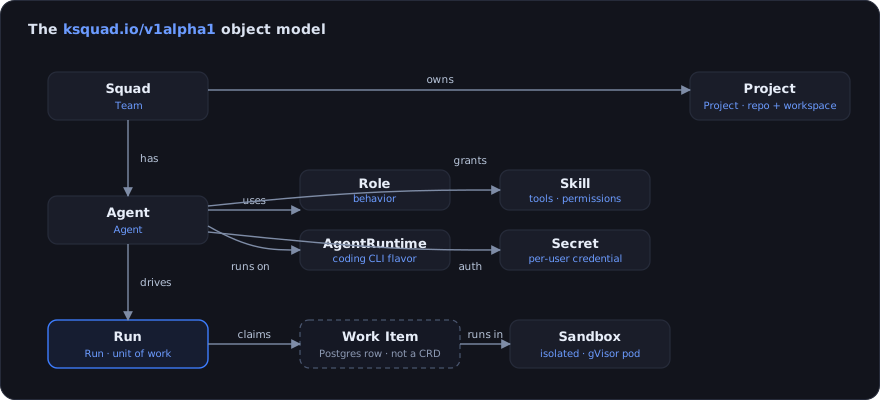
A Squad (Team) owns one or more Projects and has Agents. Each Agent composes a Role
(behavior) with Skills (tools and permissions), runs on an AgentRuntime (which coding CLI), and
authenticates with its own Secret. An Agent drives a Run, which claims a durable Work Item
(a Postgres row, not a CRD) and executes in an isolated Sandbox.
Two records, one database
Section titled “Two records, one database”Two distinct kinds of durable state underpin every concept, and both live in one Postgres:
- The coordination record — work items, claims, leases, comments, and artifacts. This is how agents coordinate without ever talking to each other directly, and it doubles as the audit trail.
- The knowledge record — the squad’s memory, served by a first-class memory service so knowledge compounds across runs.
Keeping these two records separate and durable is a deliberate design choice: coordination state is never trapped inside a pod, and knowledge outlives any single Run.
Desired state vs. durable state
Section titled “Desired state vs. durable state”- Desired state —
Team,Agent,AgentRuntime,Role,Skill,Project,Run,OTelConfig— is expressed as CRDs and reconciled by the operator. - Durable, high-churn app state — work items, comments, claims, artifacts, memory, users — lives in Postgres, behind the apiserver and memory APIs. These are not CRDs.
Knowing which side of this line a thing lives on tells you how to interact with it: kubectl /
console-compose for desired state; the console and APIs for the durable record.