Runs (Run)
CRD: Run (ksquad.io/v1alpha1)
A Run is a unit of squad work. It’s the heart of KSquad’s “reconcile, don’t glue” bet: instead of heartbeat scripts nudging agents along, a Run is a reconciled Kubernetes workload with an explicit, crash-safe state machine. A controller restart never double-drives a Run, and no coordination state is ever trapped inside a dead pod.
apiVersion: ksquad.io/v1alpha1kind: Runmetadata: name: fix-flaky-tests namespace: ksquad-systemspec: teamRef: payments-squad projectRef: payments-api agents: [dev-1] workItemRef: wi-8123 # opaque pointer to a durable work item (optional) inputs: task: "Stabilize the flaky payment-retry test." sandboxPolicy: runtimeClass: gvisor retryPolicy: maxRetries: 2The lifecycle
Section titled “The lifecycle”A Run moves through an explicit set of phases (its status.phase):
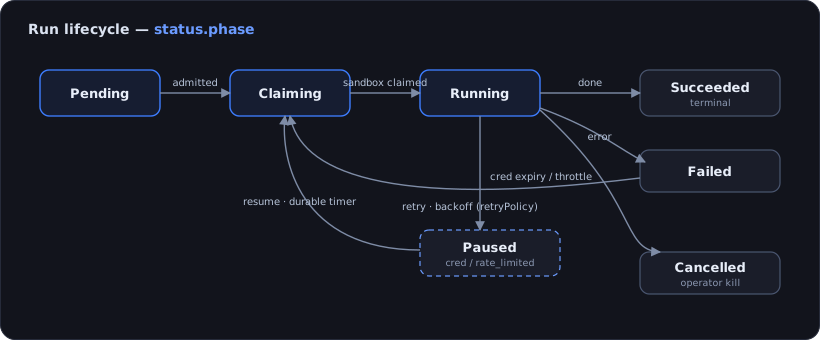
- Pending — the Run is admitted and waiting to be scheduled.
- Claiming — the Run reconciler requests a warm sandbox and assembles the pod: it stages the toolchain packs and capability-gated sidecars declared by the Run’s skills. What gates latency here is claim time, not cold boot, because sandboxes are pre-warmed.
- Running — the agent is invoked over the shim (A2A); it works the item through the coordination record and memory, and progress streams live over SSE to the console.
- Succeeded / Failed / Cancelled — terminal outcomes. A failure retries with backoff per
retryPolicy; a cancel tears down the sandbox promptly (the pod is disposable). - Paused — a legible pause (never an opaque failure), used for credential expiry and rate limits (below).
Crash-safe by construction
Section titled “Crash-safe by construction”If a sandbox or agent dies mid-Run, KSquad doesn’t lose coordination state — it lives in Postgres, not the pod. The reconciler runs a fence-then-release reclaim protocol (fence the dead pod first, release the claim second), then retries with backoff. This is the core difference from heartbeat orchestration: at-most-one-holder is enforced with fencing tokens, so a controller restart can never cause two agents to drive the same work.
Work items and claims
Section titled “Work items and claims”A Run references a durable work item (workItemRef) — it doesn’t own or embed it. Work items,
claims, comments, and artifacts are rows in Postgres, behind the apiserver’s coordination API. At most
one agent claims a work item at a time, holds a lease on it, and the claim is fenced so a
crashed holder’s stale writes are rejected. This is what “coordinate through durable work items, never
peer-to-peer chat” means in practice.
See Author Guide → Managing work items.
Sandboxes
Section titled “Sandboxes”Every Run executes in an isolated sandbox — a pod under a RuntimeClass (gVisor by default), in the squad’s namespace, under its NetworkPolicy. Sandboxes come from a warm pool so claim latency stays low, and they’re torn down and replaced after use rather than reset in place, so no state leaks between Runs.
Rate-limit recovery
Section titled “Rate-limit recovery”When the model provider throttles an agent, KSquad recovers automatically, in priority order:
- Fallback model (no pause). If the agent or project declares a
fallbackModel, the Run switches models mid-flight and keeps running. - Timed pause + auto-resume. Otherwise the Run enters
Paused(rate_limited)with a persistedresume_at(using the provider’sRetry-Afterwhen given), and a single durable timer wakes it — no polling, no wasted API calls. If noRetry-Afteris given, KSquad uses exponential backoff with jitter, per credential. - Re-route (persistent limit). Rather than idle indefinitely, KSquad may release the fenced claim and re-dispatch the work item to another eligible agent whose credential isn’t throttled — a control-plane re-dispatch, never agent-to-agent handoff.
Attribution is per credential, so one subscription’s limit never silently blocks or charges another.
Human attribution
Section titled “Human attribution”When a person triggers a Run from the console, KSquad stamps the triggering user onto the Run and into the coordination record and telemetry — so consumption is attributable to the human who initiated it. The Run does not inherit the user’s session; the sandbox uses only the agent’s own credential.
Related
Section titled “Related”- Agents — who executes a Run.
- Author Guide → Managing work items — the coordination record.
- Observability — Run traces, metrics, and consumption metering.
- Troubleshooting — stuck or paused Runs.